
Hybrid Production Workflow – Early Tests
Working out a Hybrid Production Workflow that is based on an initial human/creative illustration and human performance. We did not spend alot of time with the generative AI design elements here, as this was an exercise in workflow more than design.
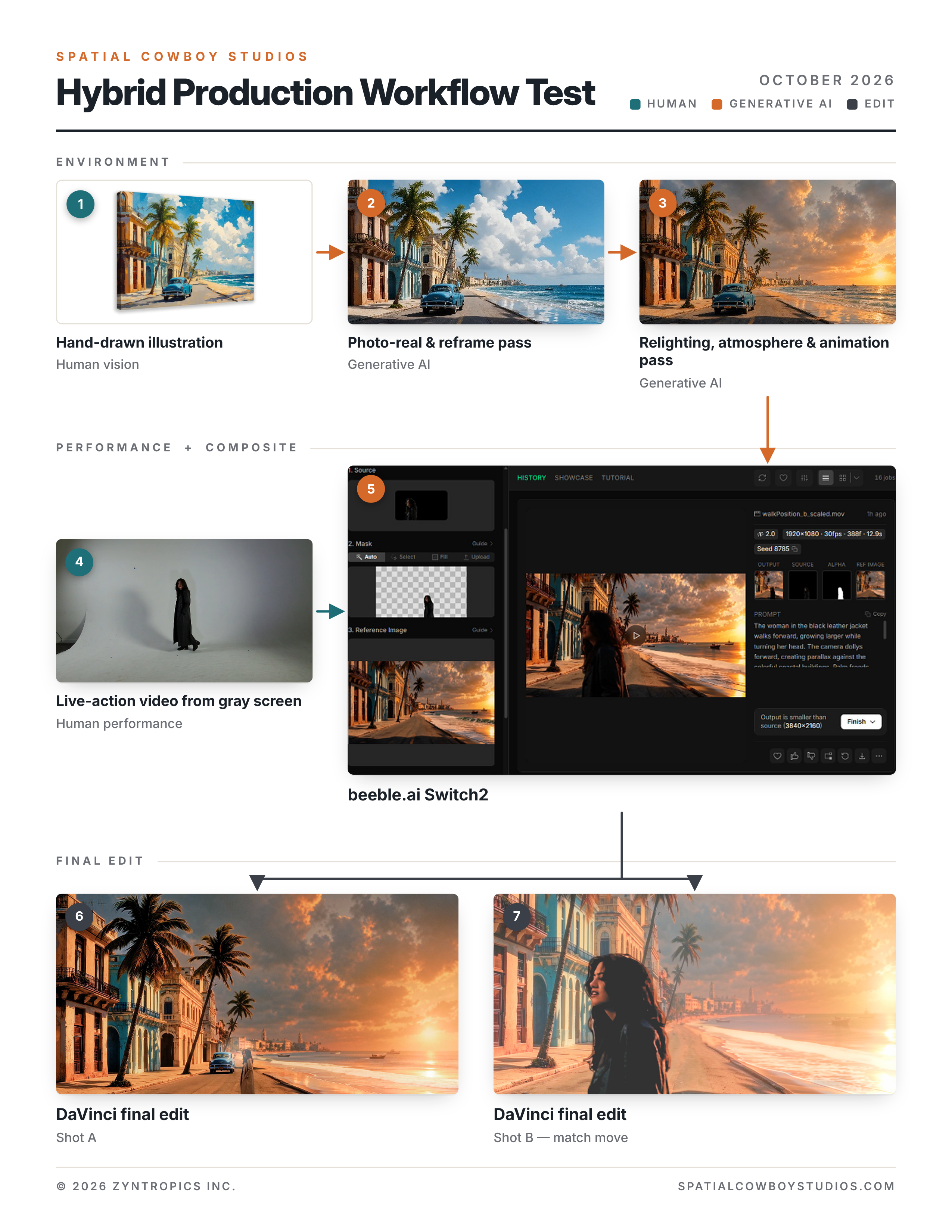
Spatial Video, Generative AI Backgrounds, Relighting, Keying and Matchmove Tests
Taking our Spatializer footage into new realms by working with the new tools offered from beeble.ai — we see a whole new hybrid workflow prospect opening up.
Production Tests with Spatial Video and Generative AI Video
Early tests to refine the pipeline for working with spatial video and generative AI video, using our Spatializer Pro and Scalerizer tools to converge the two formats.
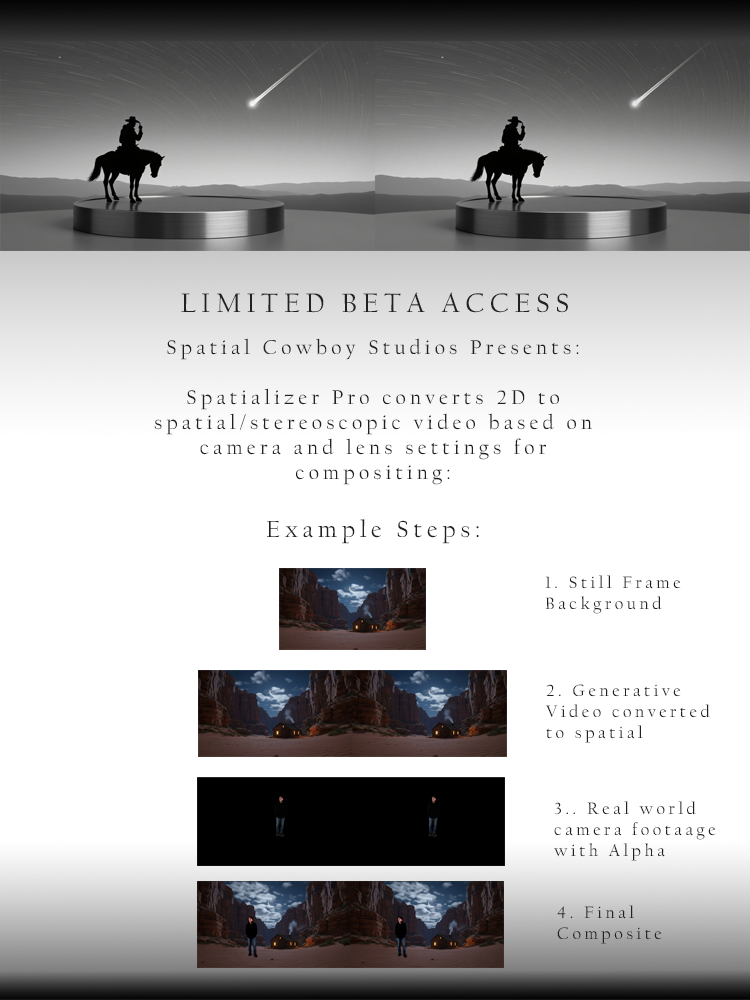
Spatializer Pro Visual How-To Guide
A quick trip through shooting live spatial video (keeping humans in the picture) to generative AI video backgrounds processed through Spatializer Pro for 3D side-by-side VR viewing.
Spatializer Pro Beta Launch
Introducing our Spatial Video Virtual Camera for Compositing and Transcoding. Limited beta access.
We have been focused on keeping human performance in the picture while working with spatial video.
If you’re shooting spatial/stereoscopic video and want to composite with flat images and (generative) video, we have built out a platform to standardize camera and lens settings to create aligned footage, alleviating parallax issues.
And yes, it can also be used to simply transcode flat video to spatial video based on presets or custom camera settings.
Expanding the Reach of Spatial Video
Sure, VR with spatial/immersive/stereoscopic video is a great experience. But even on Oculus, in terms of users, it feels niche. When you shift the discussion to Blackmagic and Apple Vision Pro, now we’re into sub-sub-niche turf. Fantastic quality, but low consumption at a very high price (we’re glad they are doing it, though). Note: we use Blackmagic’s DaVinci Resolve for our editing, which is exceptionally reasonable.
What if we could expand the use of VR footage to the web browser for traditional screens and mobile AR? It would be a different experience, but would we deliver more “depthiness” — more presence and intimacy for the user?
Since it will probably be a while before everyone has 3D screens on their desks or mobile devices, we focused on solutions for today.
Earlier this month, we shared some early test shots during NAB (well received). We are exploring integrations with established AR platforms. And yup, we’ve got demos from a recent shoot to share. Give us a shout if you’re interested.
The Trip from Volumetric to Spatial
We’ll save the story of the past year+ for another day. Today, we are looking forward as we commence our new venture into spatial video production and distribution. We are excited to work with a production format that is not restricted in terms of visual style and creativity on set or in post. Image quality is exceptional. We have attracted traditional video professionals to this space (in part because this format uses tools and techniques that are familiar to them rather than alien). We have also launched, in beta, a web-based distribution platform for spatial content, with pending integration for further AR channels.
Looking forward to the stories we create and can tell…
Exploring the Range of Volumetric Video Tools
While we often have platform preferences, we are platform agnostic — and always exploring new volumetric tools that are the best fit for whatever application we are producing.
Recently, we were fascinated by Volograms‘ latest offering, “Messages.” Side note: the Volograms team is extremely important to the volumetric industry with their innovations and consumer-facing products.
After some quick tests, we brought in a DP, lighting and talent to see what quality level we could hit. Here is the result (for webAR):
Just Before AWE: On-Set Practical Lighting Demo
Working with a traditional film DP to explore methods for on-set lighting of volumetric talent.
Pondering Volumetric Video, Augmented Reality and Story
Sometimes we’ll take a step back and question this quest we’re on: converging volumetric video with augmented reality (AR) to create storied engagements.
It seems as if there would be far more activity pursuing this format — we hope there will be.
I was having a discussion with a fairly well-known AR company executive the other day that triggered this post. His take on AR was that its interactive features were what was driving users, while also noting that AR still had a long way to go before becoming a mainstream media format.
Not everyone (perhaps no one) will agree with this analysis, but here it goes…
- “Lean forward” and “lean back” variables for defining “immersive media” are overly simplistic.
- The most “immersive media” formats are film and live music, followed closely by recorded music and theater.
- What is meant by “most”? Those media formats engage a range of senses and emotions that are far more complex and deeper than “clicking.” Going further, they are also formats that trigger memories with accompanying emotions. And in the case of live music, an individual can become one part of a unit of 20,000 that has a life of its own…
Volumetric video delivers human performance into 3D spaces — AR and VR (cumulatively, XR).
Augmented reality is content most widely consumed via mobile device, but glasses and holographic screens are emerging as distribution platforms.
Augmented reality with human performance is a new language of film… with all the potential to complement one of the most immersive of media.
Basically, volumetric video can evolve AR from “clicks” to engaging with human emotions. And, like film and television, this is all best when wrapped up in a story.
We are only just scratching the surface of incorporating volumetric video content with augmented reality. We’re bringing filmmakers into the process… and actors… to see what we can create. It’s exciting times. Our hope is that with the costs of production and distribution dropping, we’ll see many more productions explore this format and deliver meaningful, immersive experiences to many.
ghostParticles AR Screen Recording Preview
Preview of an AR screen recording for upcoming ghostParticles episodes.
Teaser: Upcoming Storied Demo
Teaser for an upcoming storied demo from Spatial Cowboy Studios.
webAR Tests Underway
webAR tests are underway, along with processing UV maps before running OBJ sequences out to webAR.
Testing the New Volumetric Stage
We’ve been busy testing various production techniques and output options for the new volumetric stage. Here’s a really brief taste of output to framed video…
Volumetric Video Stage Opens
Opening November 2022: the Spatial Cowboy Studios volumetric video stage. Houston-based, yet portable, for recorded and real-time volumetric content.
SXSW 2022
We had a fantastic time at SXSW this year, running workshops, demos and panels for independent volumetric video production with SOAR Volumetric, AMP Creative, Volograms and special guests from Sense of Space. Pleased to see old friends and make new ones during our time in Austin. Showreel below:
Wonderland in the Forest
Our friends at Sense of Space in Finland, who developed the volumetric video editing and webAR delivery platform SenseXR, took our Wonderland project out for a spin in the forest — where, perchance, they found a rather magical trail that lined up just perfectly with Alice’s entrance into and exit from the scene…
This is our new favorite screen recording of the webAR experience of Wonderland. Now we just need to find that forest location ourselves…